
Don’t touch the dressing!
The cardiac surgery program at Vancouver General Hospital (VGH) has seen a significant reduction in surgical site infections over the past five months.
A major contributor to this reduction has been Vancouver Coastal Health’s implementation of the American College of Surgeons National Surgical Quality Improvement Program (NSQIP – thank goodness for acronyms). This partnership was the catalyst for forming the Cardiac Quality Improvement multidisciplinary team. Becasue of this team, since July 2013 there has only had only been two minor infections; both of which were on harvest limbs as opposed to the deep sternal wound infections that occurred in the past. Before that, the program was experiencing one to two surgical site infections every month.
“If we had a patient with an infection on their sternum, they’d be here for a long time,” says Howard Paje, a clinical nurse educator with the Cardiac Science Program at VGH. “Whether they needed six weeks of antibiotics or they needed a negative pressure-type dressing to help with the healing or if they needed to go back to the OR, that’s three possibilities that could contribute to increased morbidity/mortality and length of stay for the patient as well as an increased workload for staff.”
Based on data
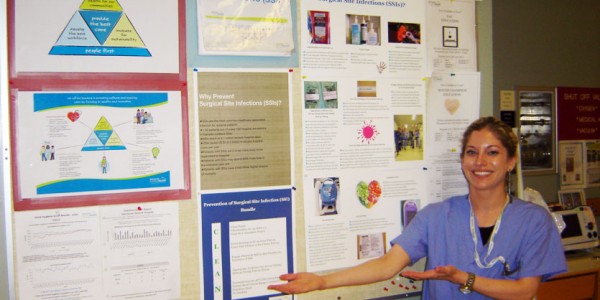
“NSQIP gave us some data, then some resources to research and to compare what we were doing, our numbers, to the standard of practise everywhere else,” Howard tells me, “within our focus group, we put a bundle of recommendations together, a list of things to do and implemented them.”
Implemented across 24 sites in B.C., NSQIP uses a peer-controlled, validated database to measure pre-operative risk factors, intra-operative variables and 30-day post-operative results. All of this information helps organizations like VCH measure and understand their own outcomes and compare with other authorities.
Barbara Drake, the NSQIP clinical quality and safety coordinator who has worked with Howard and the cardiac group for just over a year, says she was impressed with the comradery of the people involved. This collaborative team is building on previous quality improvement work. Infection Control has done a lot of work with the clean hands program and the nasal decolonization program. Other initiatives are perioperative glycemic management and standardizing cardiac surgery pre-operative orders to include chlorhexidine wipes.
“It’s involves a good team, with a lot of great effort” Barbara says. “Staff from many disciplines and different departments have come together to improve patient care.”
Effective changes
Changes were put into practise by nurses, physicians and anaesthesia staff. Some recommendations put into place included:
- Re-dosing of antibiotics during surgery to help decrease the chance of an infection.
- Leaving the sternum dressing on the patient for three days instead of disturbing the site earlier
- Changing the type of dressing to a new silicon non-porous dressing.
- Utilizing the COBAN compression wrap to decrease swelling in the harvest limbs
After months of research, training and meetings, Howard says he is impressed by how little work it has taken to get buy in from the staff, resulting in an increased benefit for both the patient and program.
“It’s not that we implemented extra work, we’re leaving the dressing on – we don`t have to take it off or dress it – it’s just there,” he says. “It was just some tweaking, changing our way of thinking.”
“That was the hardest part, getting staff to not touch the dressing,” he adds with a laugh. “As a nurse – and physicians as well – we are all ingrained in thinking, ‘If there’s a wound, I need to look at it.’ But after a couple of weeks, everybody bought in and it’s been great ever since.”